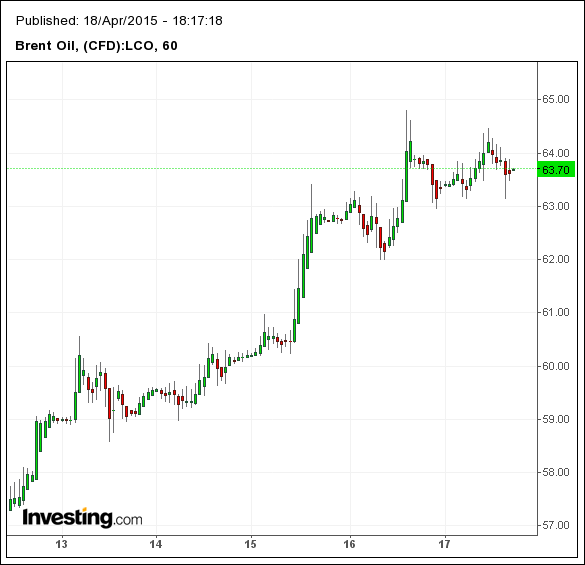
Nigeria, one of the foremost exporters of petrol, Brent crude, in particular, should be heaving a sigh of relief that the price of oil is rising slowly.
The conflict in Yemen has been attributed to this development. On thursday, tribal forces took control of a major southern oil terminal and airport.
What has been worrisome about the Nigerian reaction is the news coming from the Central Bank of Nigeria, (CBN).
First, it's pushing a hasty capitalization policy on the banks, especially on the strategically important banks in order to meet capital adequacy requirements. Many of the banks have been carrying out dividend reinvestment plans for this purpose.
Secondly, if foreign exchange reserves was the reason behind the CBN's reduction of the annual amount holders of naira denominated ATM cards are allowed to spend to buy goods from overseas,(from $150,000 to $50,000 per year), then there are possibilities that it could go back to the days before the boom when the price of Brent Crude was above $105 per barrel by instituting financially repressive regimes that not only hurts the economy, but the "common man" who will always respond to the dictates of the market.
Brent Crude risen beyond $60Credit: Investing.com Brent Oil Streaming Chart
Some online news reports state that the CBN is afraid of creating arbitrage opportunities that could leak away badly needed foreign exchange reserves.
The 2015 budget presented by the Finance Minister, Ngozi Okonjo-Iweala, was placed at a benchmark price of $52 per barrel. So, this Thursday's record rise to $64 per barrel of Brent Crude will surely cause some nerves to ease off a little.
Nigeria has a duty to commit themselves to eradicating a thriving black market in the country. That is what created the arbitrage in the first place. One believes that is quite a herculean task, given the fact that the banks posting megaprofits and politicians profit from the black market trade in foreign exchange.
Time is ticking away. It is unwise for the Finance Ministry and CBN to keep putting all their eggs in one basket. The economy has to diversify and get it done fast by encouraging other sectors of the country to be more innovative and productive.
I read the news concerning the disagreement between the Nigerian Deposit Insurance Corporation (NDIC) and the Central Bank of Nigeria, (CBN) from several online channels but was delighted with the reporting by Vanguard online.
Judge on right, juror on left!Credit: Plum on flickr
I believe the two heads of those institutions, Godwin Emefiele, the CBN Governor, and the NDIC Managing Director and Chief Executive Officer, Alhaji Umaru Ibrahim, assuaged many consciences when they kept making reference to the depositors interest and the interest of the banking industry. I also believe the case in point, whether NDIC was seeking “judge and juror” powers (methinks he meant “jury’?), was a dilemma – none of the offered possibilities which are the points in contention are practically acceptable.
I’ll reference two points outlined in innocence in the Vanguard article.
One wonders what a bank would think if accused to have “grievously violated its obligations under the NDIC Act?” That accusation rests with the CBN to decide when and how. If the NDIC and CBN do not agree on how grievous a violation is, a bank would always resort to CBN’s definition as its only protection.
Secondly, a bank that is contesting its proscription in court has not been found guilty. It has a duty to its depositors and would fight with its teeth to keep those depositors. But, when the NDIC has decided that the depositors would have to be protected and advise them to go for their deposits, then, she has decided the bank was guilty as charged when the court has not rendered a verdict. By the way, the NDIC issuing such a prescription to depositors and the bank winning in court would be a tragic case for the shareholders and investors concerned, not to talk of the health of the banking industry. Whatever way you look at it, the bank's losing at court or the depositors asking for their deposits would mean the bank was insolvent. But what if the bank won? That would be jungle justice.
The NDIC should not play “judge and/or [sic] jury”; which should it play?
It’s a question of the CBN and the NDIC needing a consensus on "powers of oversight over banks." I really do applaud the attempt being made by Alhaji Umaru Ibrahim to rope in banking subsidiaries into the NDIC net. It’s a loophole that’s been gaping for a long time.
Talking of dilemmas and choices, which ironically was the subject of my cartoon the day after, the depositors and banks fall into this situation. Depositors would be said to be facing a “double bind” dilemma, while banks would be placed in a “Morton’s Fork” by the NDIC when considering a litigation.